Now Reading: The Future is Submerged: Australia’s First Underwater 3D Printing Unveiled by LUYTEN 3D & UOW
-
01
The Future is Submerged: Australia’s First Underwater 3D Printing Unveiled by LUYTEN 3D & UOW
The Future is Submerged: Australia’s First Underwater 3D Printing Unveiled by LUYTEN 3D & UOW


Introduction: Diving into a New Era of Construction
LUYTEN 3D and the University of Wollongong (UOW) have recently unveiled a monumental advancement in additive manufacturing. This initiative marks a “world-first” milestone, establishing Australia’s leadership in the specialized field of underwater 3D printing technology.
This breakthrough arrives at a critical juncture for global infrastructure. By moving beyond terrestrial boundaries, this partnership addresses the complex logistical hurdles that have long hindered the expansion of marine and offshore facilities.
The project signifies a shift from traditional, labor-intensive processes to automated, precision-engineered solutions. For marine engineers and defense contractors, this represents a new frontier in structural durability and deployment speed.
The Urgent Need for Innovation in Underwater Construction
Current challenges with traditional methods
Traditional underwater construction is defined by high operational costs and significant safety risks. Deploying divers and heavy machinery into high-pressure environments requires extensive life-support systems and specialized insurance.
Furthermore, conventional methods often rely on pre-cast elements or complex formwork that are difficult to position accurately on the seabed. These processes frequently result in project delays and substantial material waste.
Environmental impact remains a primary concern for port authorities and environmental agencies. Traditional pouring methods can disrupt local ecosystems and introduce pollutants into sensitive marine habitats.
The growing demand for robust and sustainable marine infrastructure
There is an escalating global demand for infrastructure that can withstand rising sea levels and extreme weather events. Civil engineers are increasingly tasked with building resilient coastal defenses and port facilities.
The renewable energy sector also requires stable foundations for offshore wind farms and tidal energy converters. These structures must be durable enough to survive decades of saltwater corrosion and hydraulic pressure.
Sustainable development is no longer optional for modern contractors. There is a pressing need for construction techniques that reduce the carbon footprint of marine projects while enhancing ecological integration.
A Breakthrough Collaboration: LUYTEN 3D and UOW
Briefly introduce both entities and their expertise
LUYTEN 3D is a premier leader in mobile 3D concrete printing, known for developing robust robotic systems capable of operating in diverse environments. Their technology focuses on efficiency and material optimization.
The University of Wollongong (UOW) is a world-class research institution with a deep specialization in materials science and structural engineering. Their researchers provide the academic rigor necessary to validate new manufacturing frontiers.
Highlight the synergy and vision leading to this innovation
The synergy between LUYTEN 3D’s technical agility and UOW’s research depth has accelerated the development of this underwater capability. Their shared vision focuses on solving real-world engineering bottlenecks through automation.
By combining advanced robotics with proprietary material mixes, they have created a system designed for sub-aquatic stability. This collaboration aims to set a new global standard for how offshore and defense assets are maintained.
Ultimately, this partnership seeks to transform the blue economy. It provides a roadmap for autonomous construction that is faster, safer, and significantly more sustainable than any previous methodology.
Unpacking the World-First Technologies
The advancement of marine infrastructure requires a departure from traditional construction methods. Recent breakthroughs in submerged 3D printing are redefining how we build in aquatic environments.
By integrating advanced robotics with material science, engineers can now execute complex designs directly on the seabed. This eliminates many of the logistical hurdles associated with offshore civil engineering and defense projects.
Accelerator-Free Underwater Concrete: A Material Revolution
Composition and Properties
Traditional underwater concrete relies heavily on chemical accelerators to ensure rapid setting. However, a new class of accelerator-free concrete is transforming the industry through superior rheological control.
This material uses a proprietary blend of binders and aggregates designed to maintain structural integrity without harsh chemical additives. This creates a highly stable mix that is specifically optimized for robotic extrusion.
Environmental and Performance Benefits
The removal of accelerators significantly reduces the environmental footprint of marine projects. Fewer chemical additives mean less leaching into sensitive aquatic ecosystems, which is vital for environmental agencies and researchers.
From a performance standpoint, this concrete achieves a more uniform crystalline structure. This leads to higher long-term compressive strength and better resistance to sulfate attacks common in saltwater environments.
Overcoming Traditional Limitations
This innovation directly addresses the chronic issue of “washout,” where cement paste separates from the aggregate in water. The new mix remains cohesive even when exposed to turbulent currents during the placement phase.
By controlling the setting time without accelerators, engineers gain a wider window for precise placement. This ensures that the layers bond effectively, preventing the cold joints that often weaken traditional underwater structures.
Australia’s Pioneering Submerged 3D Printing
The Concept of Underwater Additive Manufacturing

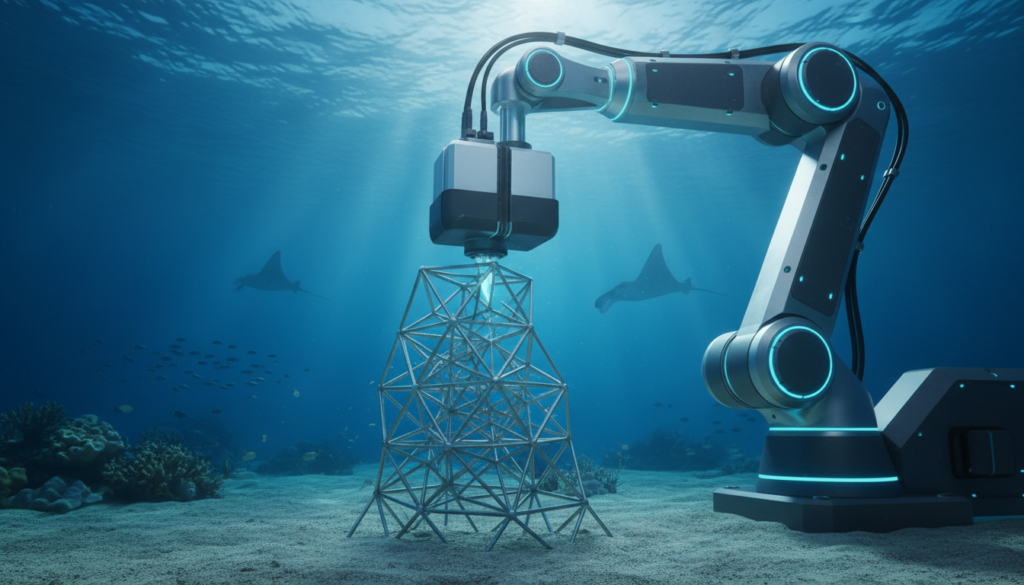
Underwater additive manufacturing represents the next frontier for defense contractors and port authorities. It allows for the autonomous construction of reefs, piers, and protective barriers without the need for dry docks.
This process involves the layer-by-layer deposition of material in a fully submerged state. It offers unprecedented design freedom, allowing for biomimetic structures that can support local marine biodiversity.
Technology Developed by LUYTEN 3D and UOW
The technology developed by LUYTEN 3D in collaboration with the University of Wollongong (UOW) utilizes a specialized robotic system. This system is designed to extrude concrete with extreme precision while completely immersed in seawater.
The collaboration has produced a mobile platform that can be deployed from vessels. This allows for on-site fabrication of critical infrastructure, reducing the carbon emissions associated with transporting pre-cast elements.
Overcoming Technical Challenges
Engineers had to overcome significant hurdles, including hydrostatic pressure and limited visibility. The system uses advanced sensors and feedback loops to maintain robotic control despite the unpredictable nature of the ocean.
Material delivery was also a primary concern, as the concrete must be pumped through specialized conduits without clogging or thinning. The LUYTEN 3D system manages this through a synchronized delivery mechanism that compensates for external water pressure.
Transformative Applications and Impact
The adoption of underwater 3D printing is fundamentally altering how we approach maritime engineering and subsea development. By enabling precise additive manufacturing in aquatic environments, this technology addresses long-standing challenges in durability and logistics.
These advancements allow for the creation of complex geometries that were previously impossible to manufacture in situ. This shift is driving significant progress in sustainability, efficiency, and operational safety across the marine sector.
Revolutionizing Marine and Coastal Infrastructure
Modern marine engineering requires solutions that can withstand extreme hydrostatic pressure and highly corrosive conditions. Additive technologies provide the flexibility needed to maintain and expand infrastructure without traditional logistical constraints.
Repair, maintenance, and reinforcement of existing jetties, sea walls, foundations
Infrastructure like jetties and sea walls often suffers from erosion and structural fatigue over decades of service. Automated systems can now apply reinforcement layers directly to submerged foundations without the need for expensive dry-docking.
This targeted approach extends the operational lifespan of critical coastal defenses while maintaining structural continuity. It allows for precise repairs that adapt to the specific wear patterns of each individual structure.
Construction of new artificial reefs, subsea energy platforms, deep-sea habitats
The ability to print complex, biomimetic structures allows for the creation of artificial reefs that promote biodiversity. These structures mimic natural formations to provide optimal habitats for marine life while protecting shorelines.
Furthermore, developers are utilizing these techniques to build stable foundations for subsea energy platforms and research modules. These components are optimized for hydrodynamic stability and can be tailored to specific seafloor topologies.
Potential for disaster recovery and rapid deployment in remote areas
In the aftermath of natural disasters, restoring coastal infrastructure is a matter of urgency for local economies and defense. Mobile printing units can be deployed to remote sites to quickly repair breached levees or damaged port facilities.
This rapid response capability minimizes downtime and provides a resilient alternative to traditional heavy construction. It ensures that critical transport and defense hubs remain operational even in challenging recovery scenarios.
Economic, Environmental, and Safety Advantages
Integrating advanced manufacturing into marine projects yields measurable benefits across multiple operational metrics. Companies are moving away from resource-heavy traditional methods toward streamlined, data-driven construction workflows.
Cost-efficiency and reduced project timelines
By eliminating the need for extensive formwork and temporary cofferdams, project managers can significantly reduce overhead costs. The speed of additive manufacturing allows for faster completion of subsea components compared to conventional pouring.
Streamlined logistics further drive down expenses by reducing the volume of heavy machinery required on-site. This efficiency allows for more ambitious project scopes within existing budgetary constraints.
Enhanced structural integrity and durability in harsh environments
Layer-by-layer deposition allows for the integration of specialized materials designed specifically for high-salinity environments. These printed structures often exhibit superior resistance to chemical degradation and mechanical wear over time.
Precision engineering ensures that every component meets the rigorous standards required for deep-sea operations. The result is a more resilient infrastructure that requires less frequent intervention and maintenance.
Significant reduction in material waste and carbon footprint
Additive manufacturing is inherently more sustainable, as it uses only the exact amount of material needed for the build. This reduction in waste substantially decreases the overall carbon footprint of large-scale marine projects.
Lower transportation requirements for raw materials also contribute to more eco-friendly construction cycles. This aligns with global environmental standards and supports the transition toward a greener blue economy.
Improved safety for workers by minimizing human intervention in hazardous conditions
Diving operations in deep or turbulent waters carry inherent risks for civil engineers and commercial divers. Automating the construction process allows human operators to manage projects from the safety of a surface vessel.
This shift drastically reduces the potential for accidents and long-term health issues associated with high-pressure environments. By removing personnel from the most hazardous zones, companies can maintain higher safety standards.
The Horizon: Future Prospects and Global Potential
The rapid evolution of marine engineering innovation is set to redefine the boundaries of offshore and coastal infrastructure. As global demand for resilient subsea structures grows, these advancements provide a roadmap for the next generation of maritime development.
The integration of these technologies into commercial workflows will likely establish new benchmarks for durability and performance. Engineers and project managers can expect a shift toward systems that require less maintenance while offering higher structural integrity.
This transition is not merely technical; it represents a commitment to long-term viability in the harshest environments on Earth. By embracing these changes, the industry can meet the dual challenges of economic growth and environmental preservation.
Next Steps in Research and Development
Ongoing testing, material optimization, and scaling up
Current efforts are focused on rigorous stress testing to ensure performance in extreme hydrostatic pressures. Researchers are refining composite mixtures to enhance the lifespan of components submerged in high-salinity environments.
Scaling these solutions for industrial-sized projects remains a primary objective for engineering teams. This involves streamlining manufacturing processes to ensure that high-performance materials are accessible for large-scale port and energy infrastructure.
Exploring new applications and partnerships
The versatility of these materials opens doors for collaboration between defense contractors and renewable energy developers. Joint ventures are currently exploring how these technologies can be adapted for deep-sea sensor housing and offshore wind foundations.
Expanding the scope of application ensures that the benefits of this research are felt across multiple sectors. From aquaculture to telecommunications, the potential for cross-industry utility continues to grow as new partnerships are formed.
Paving the Way for a Sustainable Future
Contribution to circular economy principles in construction
Sustainability is at the core of this technological shift, emphasizing the use of recyclable materials and low-carbon production methods. By reducing waste during the fabrication phase, the industry aligns with global circular economy goals.
The longevity of these new structures also minimizes the need for frequent replacements, further reducing the total carbon footprint. This approach ensures that marine construction contributes to a more sustainable and resource-efficient industrial landscape.
Setting new industry standards for environmental responsibility
Adopting these practices allows firms to meet increasingly stringent environmental regulations while maintaining profitability. Setting a higher bar for ecological safety ensures that marine ecosystems are protected during the construction and operation phases.
This commitment to responsibility serves as a catalyst for policy changes across the globe. As these technologies become the norm, they will likely influence future international standards for maritime environmental protection.
Global Adoption and Industry Disruption
How this innovation positions Australia as a leader in advanced manufacturing
Australia is uniquely positioned to spearhead the deployment of these advanced manufacturing techniques on a global scale. By leveraging local expertise in robotics and materials science, the nation is carving out a niche as a hub for high-tech marine solutions.
This leadership fosters a robust ecosystem of local suppliers, researchers, and specialized engineers. The resulting economic growth reinforces Australia’s reputation as a pioneer in the global maritime and civil engineering sectors.
The potential for worldwide impact on construction practices and marine conservation
The global adoption of these methods will disrupt traditional construction timelines and cost structures. By providing faster, more reliable building techniques, this innovation enables developing nations to modernize their coastal infrastructure efficiently.
Furthermore, the focus on non-toxic and non-corrosive materials supports global marine conservation efforts. As these practices go mainstream, the industry will play a vital role in restoring and protecting the world’s oceans for future generations.
Conclusion: Building Smarter, Building Deeper
This breakthrough marks a significant milestone in the history of marine and civil engineering. By combining technical excellence with ecological foresight, we are now able to construct infrastructure that is as durable as it is responsible.
The transition toward smarter, deeper construction is no longer a distant goal but a present reality. These advancements provide the tools necessary to overcome the most complex challenges of the offshore environment.
As we look forward, the focus remains on continuous improvement and global collaboration. Together, we are building a foundation for a future where technology and nature exist in a productive, sustainable balance.